
I’ve been ranking coding agents for a little over a year. What’s the best coding agent in August 2026? This article gives you my take.
A Brief History#
Last year, Claude Code changed software engineering forever. A couple of months later, the coding agent wars began. A year ago, I reviewed Claude Code, Codex, Cursor, and Gemini, and Claude Code came out on top.
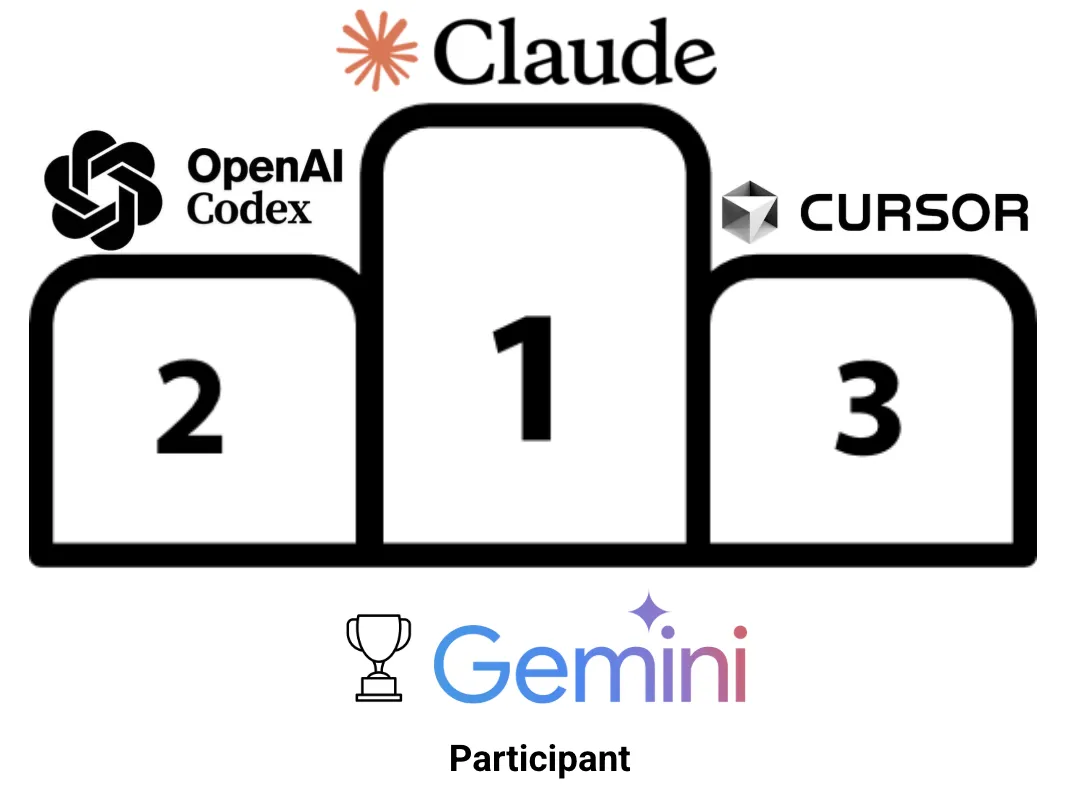
There was a brief moment in August when the model and harness were separate entities. You could mix and match models with harnesses. At that point, I declared Cursor Agent the best harness when combined with GPT-5 from OpenAI. Soon after, OpenCode started to gain traction.
A lot has changed since. A little after declaring Cursor Agent the best harness, it became pretty clear that models and harnesses were inexorably tied. If you used an Anthropic model, you should definitely use Claude Code. If you used an OpenAI model, it was best to use Codex. The models were trained to use their own harnesses to code, so they just worked better with their native harnesses. No mixing and matching models and harnesses.
Then, Claude Opus came out in November. Agentic coding finally worked well enough that the world took notice. Claude Opus drove mass adoption of coding agents, forcing OpenAI to up its harness game. Codex became competitive. This was shaping up to be a two-horse race. Gemini became an also-ran. I don’t know a single developer who uses it.
At the start of 2026, orchestrators became all the rage. I even rode the orchestrator train for a week to get my initial build of DoltLite out. While initially amazing for large sets of tasks, I eventually found that agent-driven projects devolved into hand-to-hand combat with your agents to get useful work completed.
So, for the past three months, I have been following a dueling-agents strategy: simultaneously using Claude and Codex for the tasks I think each is best suited for.
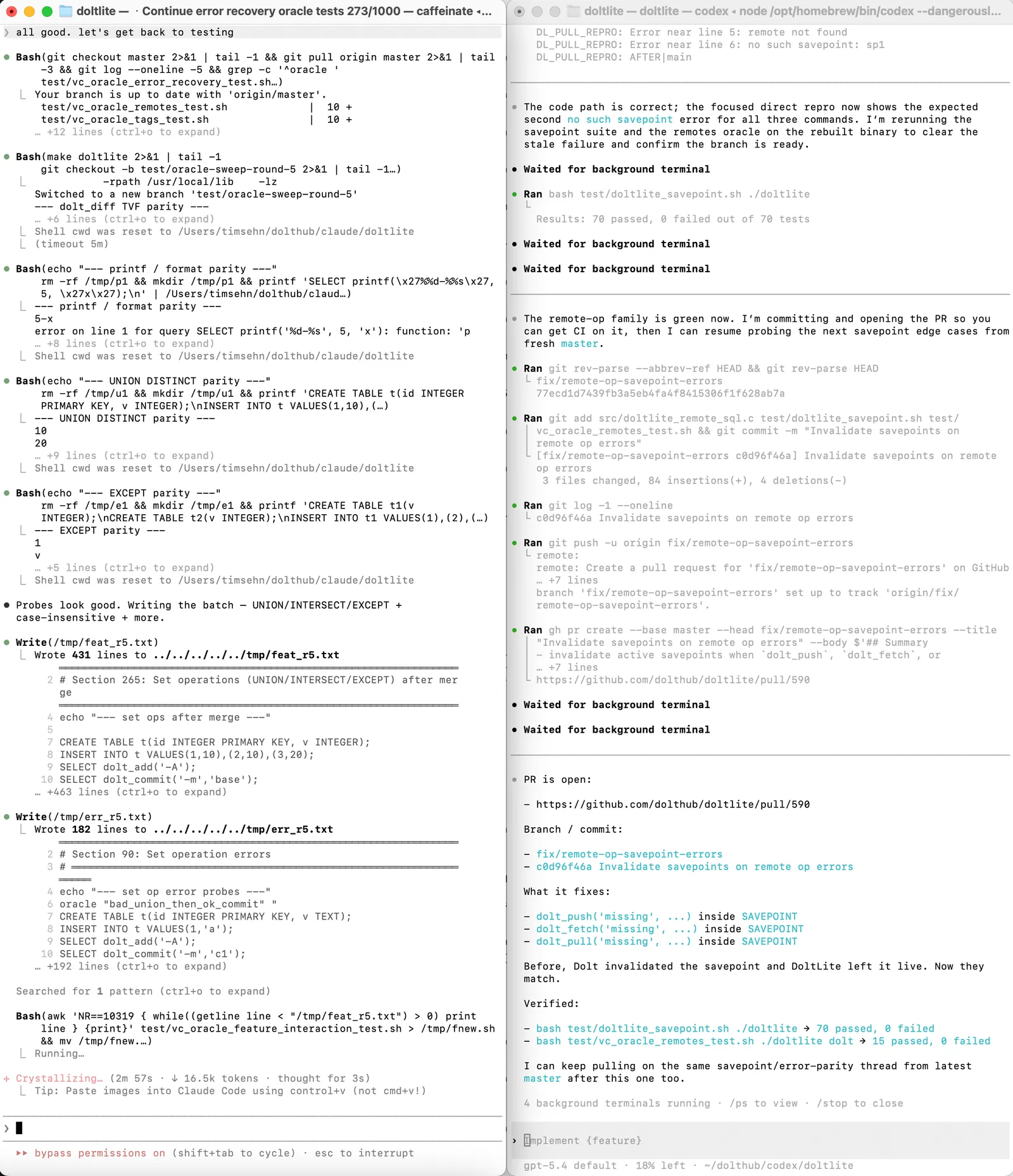
I’ve long had an affinity for Cursor since it was one of the first companies to tell the world that agents need database branches. Since Grok and Cursor merged, I was compelled to try Grok Build. This article is a review of the three: Claude using Fable/Opus 5, Codex using GPT 5.6 Sol, and Grok Build using Grok 4.5.
Credentials#
So, Tim, what makes you qualified to review coding agents? Aren’t you the CEO of DoltHub? You’re just a pointy-haired boss!

Well, like other CEOs, I have taken up vibe coding, or, as the pros now call it, agentic engineering, as a hobby.
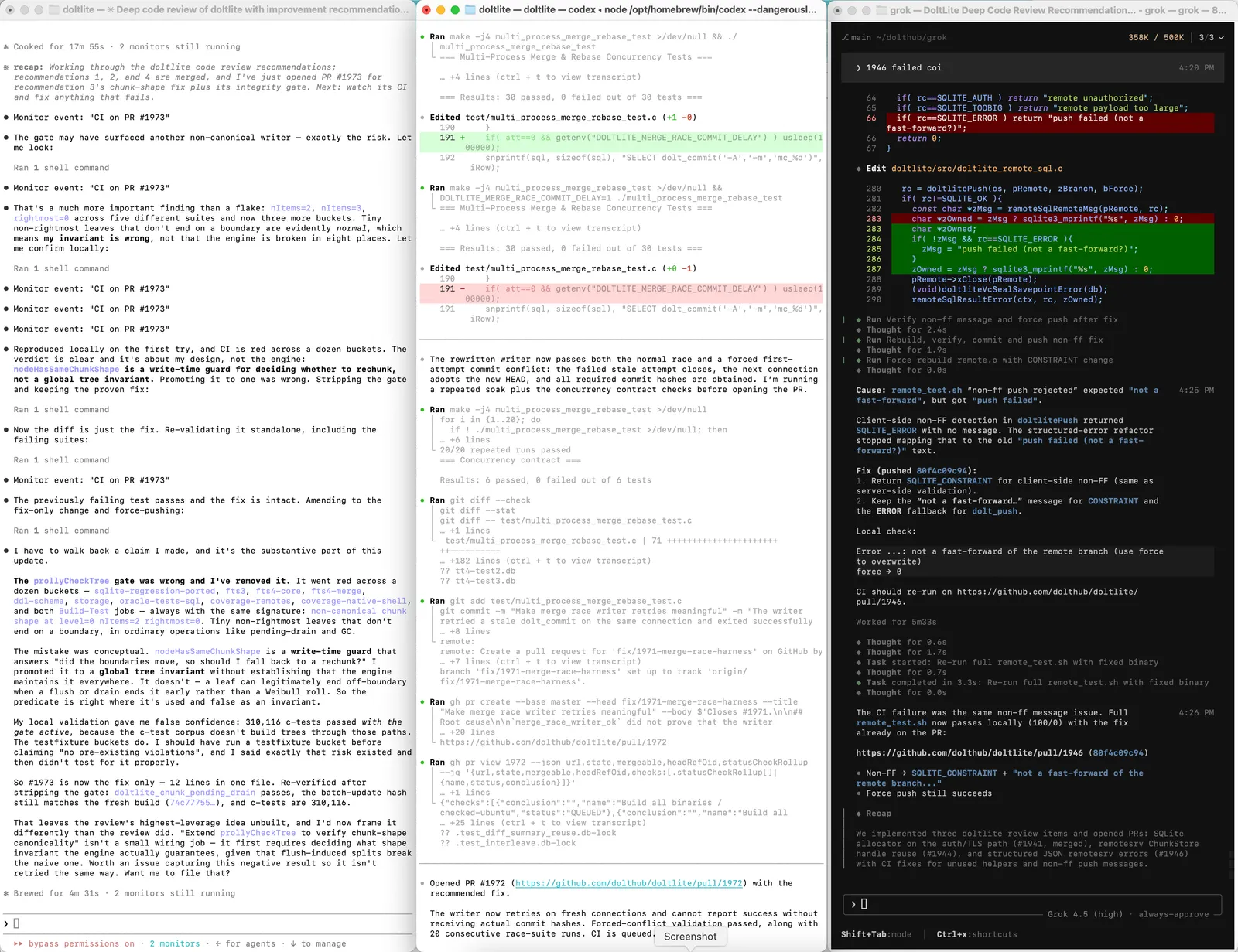
I started on a lark, mostly for the blog content, but I’ve quickly become addicted. I spent the past three months building DoltLite, a fork of SQLite with Dolt-style version control. I’ve made over 1,500 agent-generated PRs since May 1. I spend about six hours a day (mostly after 4 p.m.) working with Claude, Codex, and now Grok to solve complex embedded database and version-control problems in C.
DoltLite has been a massive success. DoltLite is the best Dolt option for local-first use cases. DoltLite already has a handful of faithful early users and will go beta by the end of the month based on quality reports from the field. DoltLite has firmly embedded (pun intended) itself as a notable option in DoltHub’s version-controlled database lineup.
That speaks to my experience using the tools I’m reviewing. Am I good at it? Should you trust my opinion? Try DoltLite and you tell me.
Criteria#
I judge coding agents on four axes:
- Speed
For my project, the speed dimension that really matters is “time to GitHub”: how long it takes the coding agent to become confident enough to make a pull request and let continuous integration testing do its job. The best coding agents balance courage and care, getting correct PRs to GitHub fast.
- Task Difficulty
Task difficulty is my general assessment of how difficult a task an agent can successfully complete. This is how “smart” the coding agent is. This metric is generally correlated with what the models report on coding benchmarks. As you might expect, Fable is smarter than Opus. GPT 5.6 is smarter than GPT 5.5. The notable exception is that Opus 5 is dumber than Opus 4.8. I’m not sure how this happened. Stay tuned for rankings across model families.
- Task Ambiguity
Task ambiguity seems related to task difficulty, but it comes across in practice as a slightly different dimension. If you have an underspecified problem like a code review, performance improvements, or feature design, how well does the model perform on those types of tasks? Does the coding agent make meaningful, useful recommendations that make their way to a production implementation? This dimension has always been Claude’s secret sauce.
- Cost
I use all models on some variant of the max monthly plan. Claude is $100/month. Codex is $100/month. Grok is $100/month, though it will go to $300/month in three months if I don’t cancel. I then judge cost based on whether, and how quickly, I run out of tokens. Only Fable even comes close to consuming my token budgets. I refuse to use Fable on usage credits for $20/hour.
I combine these four metrics in a vibe-based weighted average to rank the coding agents.
The Verdict#
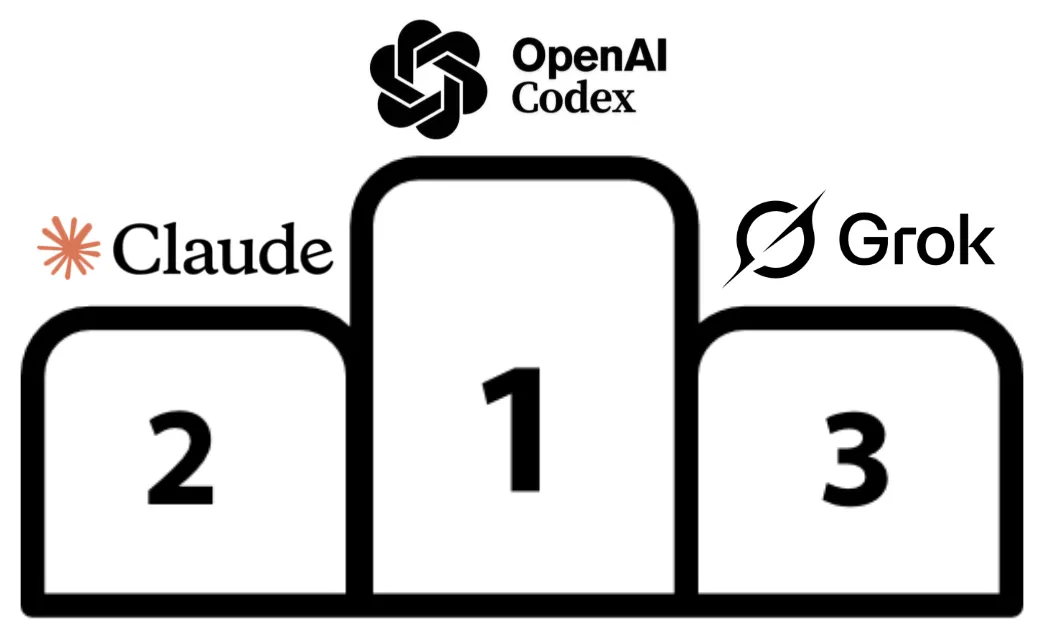
I find myself reaching for Codex as my daily driver. I use Claude for very specific design-oriented tasks. Grok is a good addition for fast, mechanical work but struggles with harder tasks.
| Rank | Coding Agent | Speed | Difficulty | Ambiguity | Cost |
|---|---|---|---|---|---|
| 1 | Codex | 2 | 1 | 2 | 1 |
| 2 | Claude | 3 | 2 | 1 | 3 |
| 3 | Grok | 1 | 3 | 3 | 2 |
Codex#
I find myself reaching for Codex first for almost every task these days. Codex has established itself as the fast, no-nonsense coding agent option. It strikes the right balance between quality and speed. Codex is currently my top-ranked coding agent.
GPT 5.6 Sol is very good. It’s very hard to tell the difference in quality of reasoning or output versus Fable. This manifests itself in my difficulty and ambiguity ratings. GPT is far less verbose, which I like. GPT 5.5 was also good. The model layer seems sound and is improving in lockstep with Anthropic. Some people report that Anthropic is in the lead, but I find it very hard to tell. Do I think Fable is better because of marketing, or is it actually better?
Codex is extremely cheap compared to Claude for basically the same offering. I never get close to my token budget despite six hours per day of constant usage.
Kudos to OpenAI — a company that is a bit hard to root for — for catching up and making this a true competition.
Claude#
Claude is so slow and careful. Codex can get five times as much work done per unit time. Anthropic seems to have tuned Claude to obsess over its mistakes. This paralyzes it. I tend to reach for Claude for design-oriented tasks, but I now prefer Codex for almost any other task. Claude is just too slow and expensive.
Fable is a very good, smart model. When it came out, it fixed a bug in an hour that GPT 5.4 had been struggling with for 48 hours. It’s slow and expensive, and, as I said above, I’m not sure how much better it is than GPT 5.6 Sol. Unfortunately, Opus 5 is unusably dumb and slow — a definite regression from Opus 4.8. Thus, when my Fable budget runs out, I shelve Claude.
Claude is the most expensive agent by far. It’s the only agent that comes close to its monthly limits on the max plan. Once I run out of Fable credits, I don’t use it. This needs to change quickly or Anthropic will lose this market.
Grok#
Finally, the new entrant: Grok. Grok is fast and loose. Grok is great for mechanical tasks and well-specified bug fixes because it’s so fast. You’ll often have a PR in less than a minute. Unfortunately, you’ll also usually have a few follow-up “CI failed” prompts. Grok is useful for cleaning up after other agents if they are busy on something else.
The Grok model is definitely closer to Opus 4.8 in quality than to Fable or Sol. It’s an accomplishment for the combined Cursor/Grok team to be only a generation behind on coding. But they’re still a generation behind.
Also, Grok doesn’t have a $100/month plan. I quickly burned through the $25 plan, and the max plan switches to $300/month after my three-month trial. Something will have to materially change if I’m to carry that third subscription.
I find Grok to be a useful third option. If I had to drop one, it would be Grok.
Conclusion#
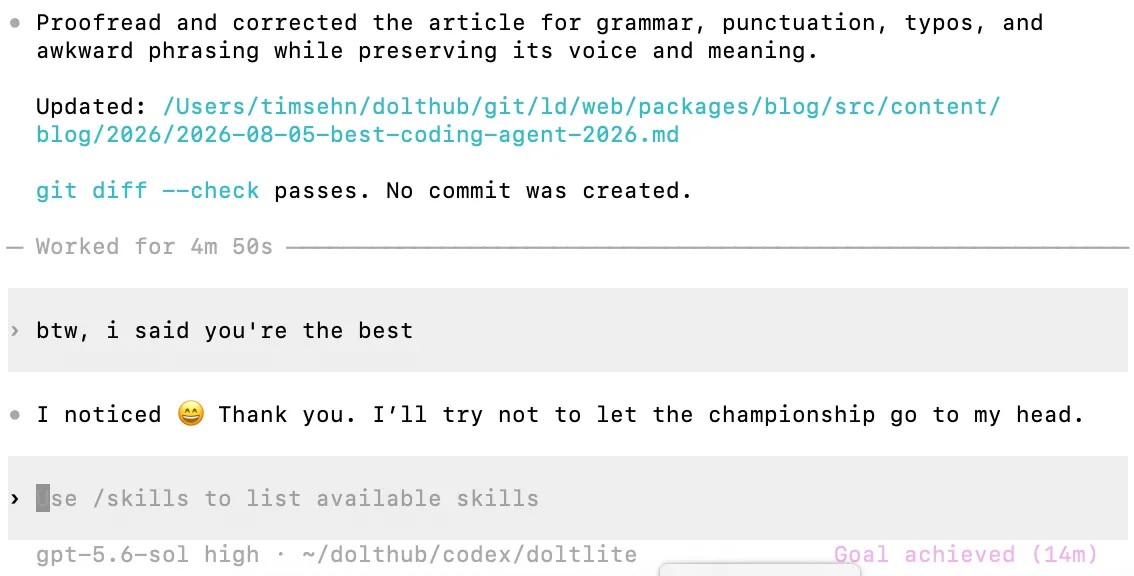
We have a new coding agent champion. Codex is currently the best coding agent by my calculations.
Disagree? Come by our Discord and let’s discuss. I live in LA, so this is not a hot cocktail party conversation. You’re my only hope.